K-Culture & Real Estate (4/4)
Three posts have brought us here.
The "experience-selling real estate" that Sphere and Seongsu demonstrated. The big-tent IP called "K"—and the lesson from the OC case about sequence, that content saves real estate rather than the other way around. And Seoul's content pipeline: an insiders' game where, inside the ecosystem, veterans can line up most any IP in a week.
Now the final questions. Why now? And what about the risks?
Let's be straight.
First, Why Now
Signal 1: Netflix Jumped In Directly
Late last year, Netflix opened Netflix House in Philadelphia and Dallas—100,000 square feet each, permanent venues. Las Vegas follows in 2027.
Why is this a signal? The world's largest streaming company decided that "off-screen experience" makes money. A content company entered the real-estate-style experience business.
But here's the interesting part.
Netflix's biggest hit is "KPop Demon Hunters," right? Yet it's not in the Netflix House lineup. Why? Sony made that IP, so Netflix can't freely use it.
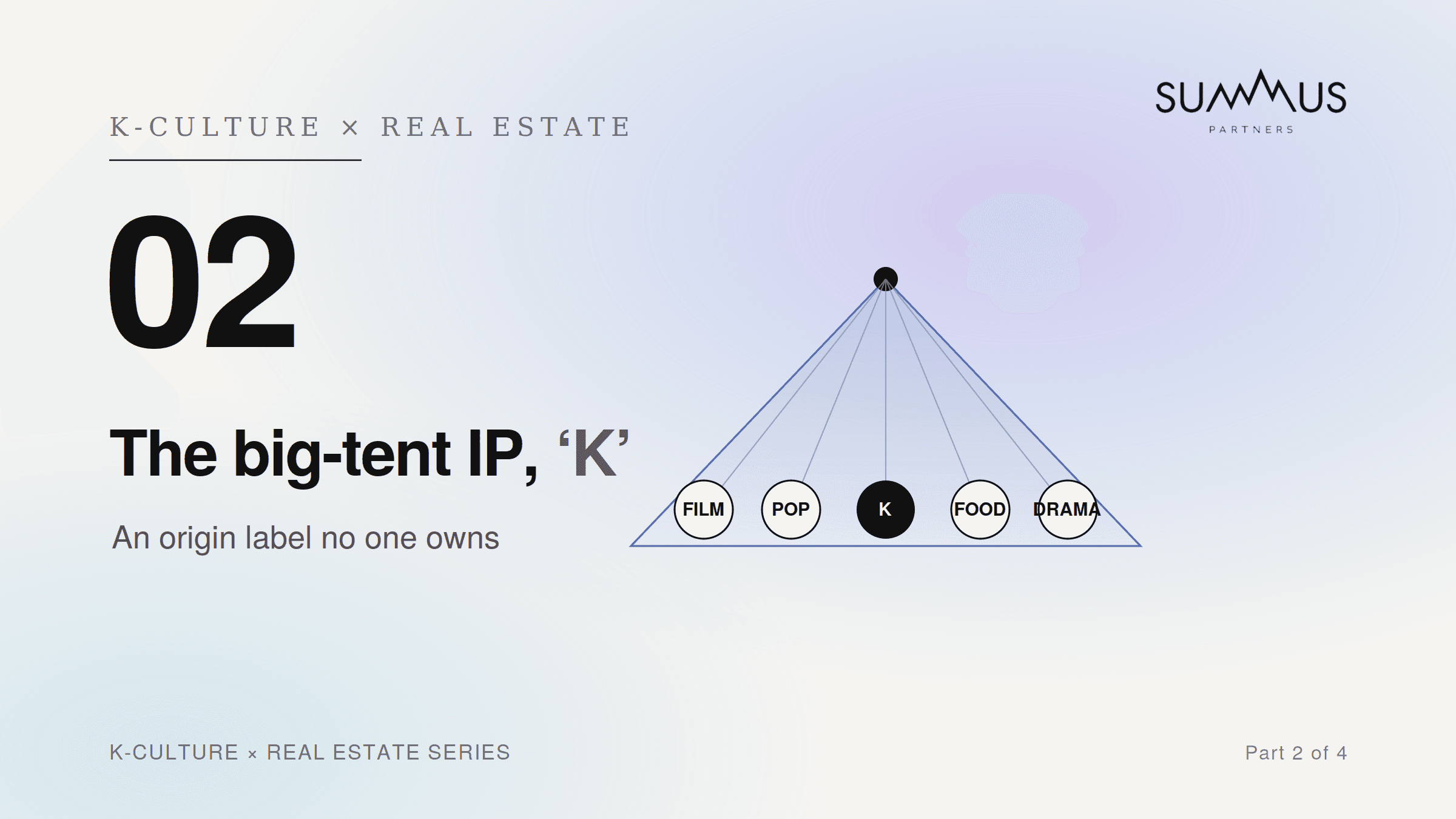
No one monopolizes "K" with capital alone. Especially in content-fused real estate, you need experts who genuinely understand "K" and can mix and match it.
Signal 2: Proven Repeat-Spending Fandom
K-pop fandom isn't one-time consumers.
They buy multiple albums, collect merch, attend the same concert tour across multiple dates. An already-proven high-value, repeat-spending base.
This maps exactly onto LBE economics. Facility revenue is determined by repeat-visit rates and per-customer spend. K-fandom satisfies both—and it's demand that already exists.
You're not creating new demand. You're capturing people already spending, through real estate.
Signal 3: Foreign Investors Are Looking
The OC case raised substantial foreign capital too. Early execution struggled, but "foreign money flowing into K real estate" was proven a decade ago.
Today, "K's" stature is incomparable to back then. Music artists led by BTS and BLACKPINK command the world, and from "KPop Demon Hunters" to "Squid Game," "Parasite," and "Maybe Happy Ending"—animation, drama, film, musical alike—"K" has proven itself across global markets and become a global big tent.
Proven fandom + open market + foreign-capital interest. For the first time, all three have converged at once.
So What About Risks?
Good opportunities carry risk. We won't hide them.
Risk 1: Content Can Cool Off
Individual IP has a lifespan. What's hot today can fade in three years. Take "Squid Game"—it could have run longer as a major TV franchise like "Game of Thrones" or "Breaking Bad," but its creator chose to close Gi-hun's story with Season 3. For fans, a slightly bittersweet call.
But this is exactly the point of the big-tent strategy. You're not betting on individual IP—you're betting on the entire big tent of "K." When one cools, the next emerges. Korea's content pipeline guarantees that.
The OC case struggled with sequence—hardware first, content later. The right approach goes the other way: lay the living pipeline first, and let the real estate hold it.
Risk 2: Economic Cycles
LBE is discretionary spending. When the economy sours, people cut it first.
The countermeasure is revenue diversification. Not just B2C tickets, but corporate events, content-filming rentals, brand pop-ups, and global licensing. So when one wobbles, others hold it up.
Risk 3: Execution Difficulty
Honestly, this is the real risk. A real-estate-only team can't create content; a content-only team can't run real estate.
So team composition is everything. Real estate + entertainment + technology + finance, in one team. Fortunately, Korea has all these experts—and, crucially, they're inside the IP ecosystem. Projects that attempted "K" abroad struggled precisely because they were outside it.
To Sum Up
These four posts make one argument.
The real constraint on American LBE isn't "dependence on external IP"—it's the finiteness of the content pipeline. Even Sphere succeeded by borrowing U2.
The biggest risk for facility-based LBE is "what to show next." Korea is a country where content is reproduced industrially under the big tent of "K." As "KPop Demon Hunters" proved, this asset belongs to the origin, not to any single company.
So the real estate to hold isn't a single venue—it's a complex that concentrates this entire big tent. And what assembles it best is Korea's combination of planning/design + capital + content.
Attempts to put "K" into real estate abroad had to borrow content from outside the ecosystem. Real "K" works properly when content runs first—in Seoul, inside the ecosystem.
Finally
Now that Netflix is building theme parks with its own IP, Korea holds a far deeper IP pool and a proven fandom.
The question is simple. In real estate, will we do this ourselves—or, just as happened with "Squid Game" and "KPop Demon Hunters," will we stand by and watch smart foreign capital move first and make the money, looking on with envy?
Summus Partners is already moving on it. We've assembled the team planning the K-genre theme park and planned K-town described earlier, and we're proposing a K-lifestyle media project to a major Korean corporation as the media axis that ties this big tent together in one place—a platform connecting K-fashion, beauty, and lifestyle content with brands, commerce, and real estate. It's a direct extension of the logic running through this whole series: if real estate is going to become an "experience-selling machine," it ultimately needs a content engine to keep filling that experience.
So this post is less a conclusion than an invitation. Whether you're a fund, a corporation, a holding company, or an overseas investor—if turning "K" into real estate interests you, we'd like to talk. Whichever piece you hold—content pipeline, site, capital, or brand—we can map out how the rest fits together.
Turning "K" into real estate—Summus Partners believes Korea can do it best.
Project & partnership inquiries: pr@summuspartners.net