K-Culture & Real Estate (3/4)
Last post looked at that K-themed mall in OC. It struggled by building hardware first and filling in content later—and what ultimately revived the space was K-content.
That raises an obvious question. Does Korea have that engine? And if so, why is Korea best at running it?
That's today's topic.
The Real Asset: A Content Pipeline
Know the biggest risk for facility-based LBE?
"What do we show next?"
Even Sphere wrestles with this. "Postcard from Earth" → "V-U2" → "Wizard of Oz"—it keeps swapping content, because when one cools, the next has to go in.
Even Netflix faces this. Last year it opened Netflix House—experiential venues in Philadelphia and Dallas—using its own IP like "Squid Game" and "Stranger Things." But the industry points out: Netflix has many shows of shifting popularity, so it needs to be nimble and keep swapping content like Meow Wolf, rather than run a traditional static theme park.
Everyone's homework is the same. How do you keep the content pipeline full?
But Korea?
That pipeline is an industry unto itself.
Film, drama, music, variety—globally successful content is continuously reproduced within a tight geography and talent pool. The film talent of Chungmuro, the broadcast talent of Yeouido, the entertainment talent of Gangnam and Seongsu—essentially gathered in one city.
Here's what that means.
An Insiders' Game
The "K-Genre theme park" Summus Partners is developing brings in partners who cut their teeth in Korean film and drama. Executive producers on films like "The Man from Nowhere" and "Snowpiercer"; a veteran who spent years selling major studios' IP into overseas markets; veterans who've coached the acting and action of some of Netflix's hottest performers today. Alongside them, veterans who've spent years in Korea's music industry—management, producing, songwriting, and rights.
The other day I watched a film called "Sandy Wexler." Set in 1990s Hollywood, it tells the real-life stories of the late Sandy Wernick, Adam Sandler's actual manager. An oddball, but one whose warmth and loyalty led him to discover and manage—beyond Sandler—the likes of SNL producer Lorne Michaels, comedian Rob Schneider, and Peter Falk (known in Korea as "Detective Columbo"). Sandler, who stayed close to Sandy for life, played Sandy himself. It's a reminder that even in the American entertainment industry—which looks like it runs purely on big agencies, business, and profit—human networks are everything.
The American entertainment industry, too, concentrates its human infrastructure in Hollywood or New York and runs as an insiders' game turning on networks within the field. Korea is a society where relationships matter especially, and just like the US, its entire entertainment world revolves around one city—Seoul. It's likewise an industry moved by professionals who've worked in it for a long time. So when veterans like these spend just a week making the rounds, they can line up most any content or IP.
Content is, in the end, a business of relationships and trust. With a network built over a career in the field, business development flows. Who holds which IP, and who you go through to make a deal happen—having that map is what matters.
Remember that K-themed mall in OC from the last post? It had plans for a K-pop venue, but locally there was no real way to reach the IP pipeline. It was positioned to borrow content from external sources, and since the developers weren't industry insiders, things didn't go smoothly.
In Seoul, by contrast, the studios, directors, actors, and music labels are all within reach, and the professionals working with Summus Partners operate on exactly that foundation of relationships and trust. Sourcing F&B and lifestyle brands is another strength of Summus Partners.
This is the decisive difference between that case and Seoul.
Anyone can do the gathering. With enough money, you can assemble Korean restaurants and merch shops. But a continuous, fast supply of living content and IP? That only works if you're inside the ecosystem. Seoul is the home base of that content pipeline.
So What Kind of Real Estate Is It?
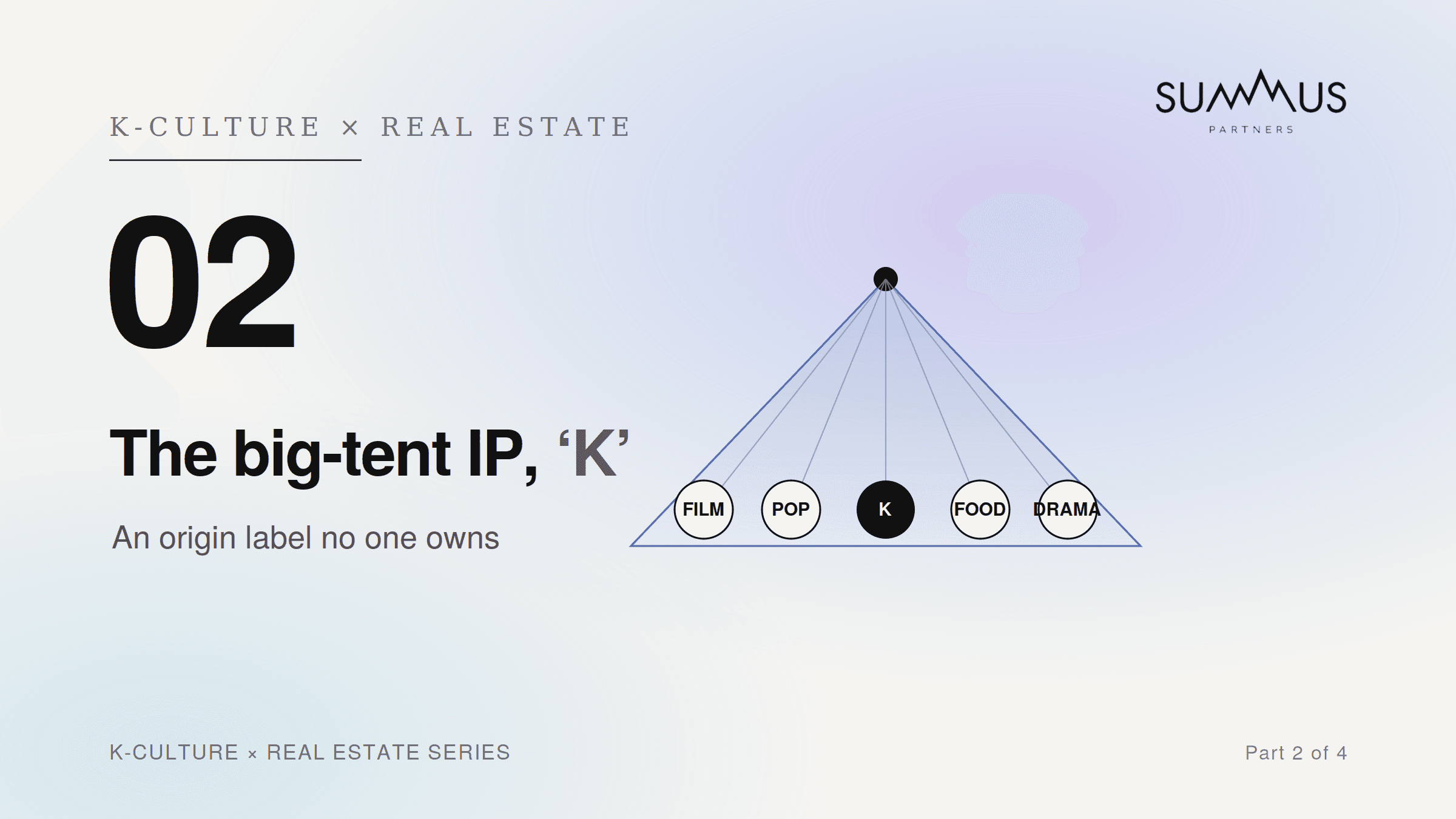
If "K" is a big tent, then music, film, drama, food, beauty, and lifestyle all fall under it.
So the real estate can't be a single-genre facility either.
A complex that concentrates K-culture, K-food, K-beauty, and K-lifestyle brands.
Concretely, forms like these:
① K-Genre Theme Park Film and drama IP rendered as experiences. What Netflix does with "Squid Game," done with a far deeper IP pool and faster rotation cycles.
② K-Culture Arena Performance + fan meetings + content filming in one place. A venue that directly monetizes K-pop's proven repeat-spending fandom.
③ Planned K-Town (the corrected version of the earlier case) Flip the points where the OC mall struggled and you get the blueprint. It built hardware first and filled in content later; it was multi-level but weak at pulling foot traffic upward; ownership of hotel, retail, and office splintered, severing the mixed-use synergy; and merchandising skewed heavily toward K-food and entertainment, exposing it to trend risk.
Plan it right from the start and you avoid all of that. Design the content engine first; align vertical circulation with the content flow; have a single operator integrate hotel, retail, and experience; anchor on K-culture while balancing the portfolio with everyday retail and lifestyle anchors. A living space where performances, experiences, and filming keep running—not just shopping and dining.
Koreans Can Assemble This Best
Every element of this combination is a Korean strength.
Planning and design: world-class
Content/brand: the entire big tent of "K"
Capital: real estate fund experience and scale
Technology: Samsung LED, LG audio, 5G infrastructure
Korean planners and designers + capital + content/brand. Other countries can't easily replicate this. The OC case showed it: from the outside you can imitate "K," but running it sustainably is another matter—and what ultimately kept that space alive was K-content itself.
But Why Now?
Netflix jumping into theme parks with its own IP is a signal that this market has opened. And foreign investors are starting to eye "K" real estate.
Timing, risk, and the opportunity Korea needs to seize now—the final post brings it together.
This is the third in a four-part series on the convergence of K-culture and commercial real estate. Next: why now, and how to manage the execution risks.
Project & partnership inquiries: pr@summuspartners.net