K-Culture & Real Estate (1/4)
Been to Las Vegas recently?
If so, you've probably seen this round building. A massive dome-shaped structure, its entire exterior an LED screen.
It's The Sphere.
Not Just a Building—a Money Machine
Between the pandemic and construction delays, it blew well past the originally projected $1.2B–$1.5B and was finished in 2023 at $2.3 billion (about ₩3 trillion). Back then, everyone was skeptical.
"Why on earth pour that much into this?"
But the last three years tell a completely different story.
Last quarter alone (Q1 2026): $266 million in revenue. Up 69% year-over-year. And one experience—"The Wizard of Oz" in 4D—sold 2 million tickets in five months. Average ticket: $150–250. Nearly double a regular concert.
Here's the key.
Traditional real estate builds something and collects rent.
A building like Sphere — an LBE asset — sells experiences.
As a good example of LBE (Location Based Entertainment), Madison Square Garden runs a 23.6% ROI. And as many of you know, rental yields on standard commercial real estate run 3–5%.
This is a completely different game.
But What Does This Have to Do with Korea?
Think about Seongsu-dong.
Fifteen years ago, just an old factory district north of the river. A normal city would've built high-rises or apartment complexes. This one didn't.
Instead, the neighborhood left room for culture, design, and content to seep in.
SM Entertainment moved its headquarters there
Designer studios and concept shops arrived
Hundreds of trendy cafes opened
Real estate prices?
Up 250% since 2015.
Remember the news about actor Song Kang buying a ₩6.7 billion apartment in Seongsu? That's the price of real estate with culture layered onto it.
So What's the Common Thread?
Sphere came at it through technology; Seongsu through the grain of a neighborhood. On the surface, nothing alike.
Yet they share one thing.
Neither sells physical space. Both sell experience.
Most people will agree up to here. The harder question is what comes next: what do you fill that experience with?
Talking Content in LBE: One Common Misconception
"America pulls this off because it has IP that travels. Korea now has global IP like BTS and BLACKPINK too — so we just need to build a big enough venue."
It's easy to think this way at first. But the logic is shaky.
SM, YG, HYBE are each publicly traded private companies. A real estate owner doesn't "own" their IP. If anything, you'd be the one paying steep licensing fees.
The Deeper Misconception
But there's a more fundamental misreading underneath.
The idea that "Sphere succeeded because of the U2 residency."
It didn't. What filled Sphere wasn't performance IP—it was the experience itself: a 16K dome, spatial audio, haptic seats, something no one had seen anywhere before. People didn't go to see U2; they went to get inside that room. Today its best-selling attraction isn't a famous artist's show but an in-house 4D production.
Seongsu makes it even clearer. It has nothing to do with performance IP. No idol concert put that neighborhood on the map. Culture, design, and lifestyle seeped in until it became a place people wanted to go.
So the Shared Formula Isn't IP
Look only at the numbers and it's easy to calculate: great venue × famous IP = returns.
But neither case worked that way.
Sphere and Seongsu both succeeded because they became vessels that hold culture. The vessels looked nothing alike—one a giant media dome, the other an aging factory district. Yet both managed to hold something you could only feel there.
IP is just one of the things you pour in. If the vessel isn't ready, no amount of expensive IP will fill it; if the vessel is built right, the IP inside can be swapped again and again.
So What's Korea's Real Asset?
Here's where it gets interesting.
What makes BTS and BLACKPINK remarkable isn't that they're well-produced K-pop acts. It's that the messages they carried landed in people's lives and became a phenomenon.
And that phenomenon didn't stop at music. The curiosity K-pop and K-drama triggered spread to live performance, to Korean food, to lifestyle, to heritage—even to the Korean alphabet.
What did all of that produce?
The perception that Korean things are somehow refined and cool.
That's an asset neither SM nor HYBE nor Netflix can own. And as something to pour into the vessel of real estate, it's far bigger and longer-lasting than any single idol IP.
The next post unpacks this with data. Specifically: why did the whole world consume "KPop Demon Hunters" as Korean, when no Korean company actually made it—and what that means for real estate investors?
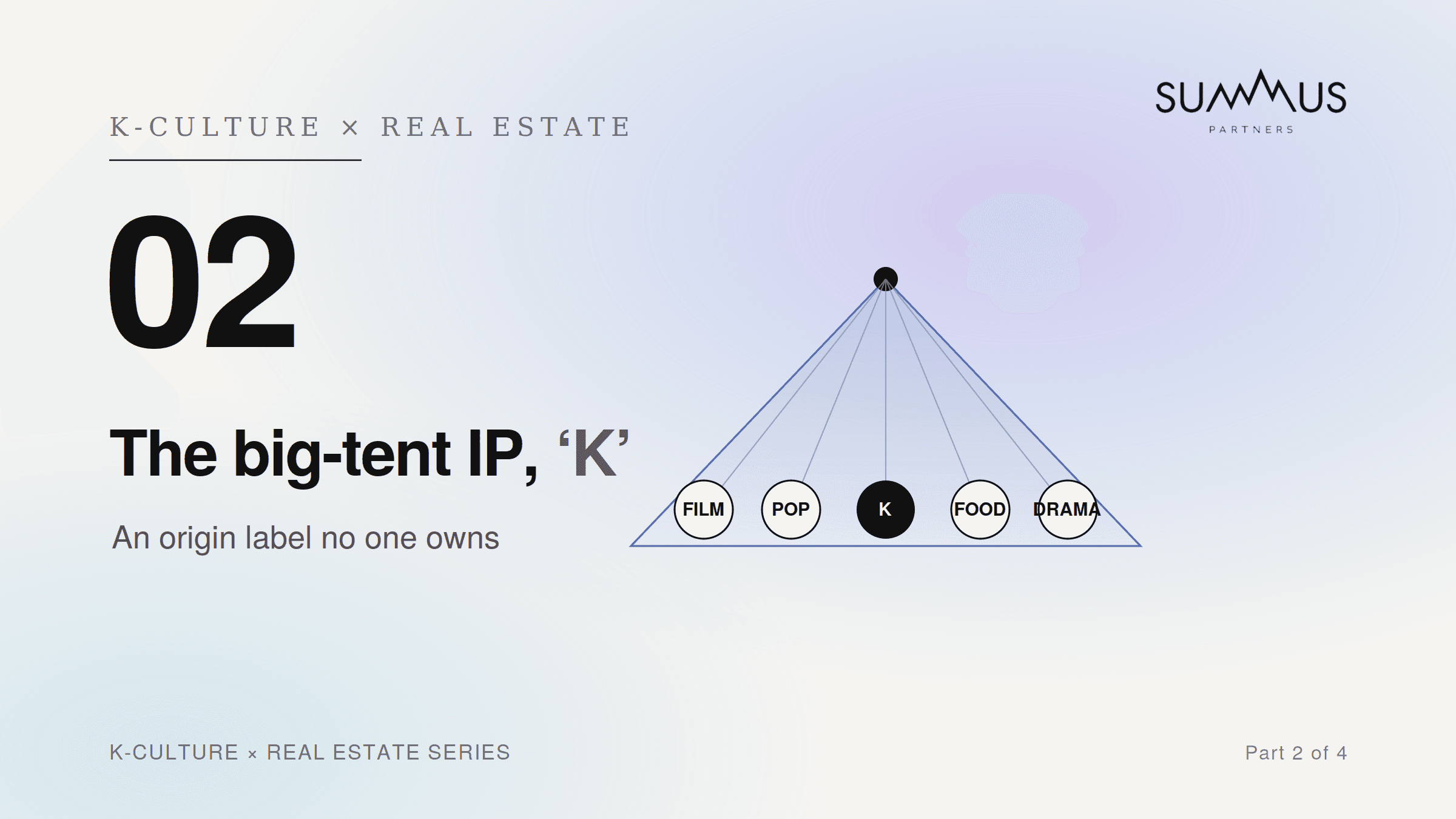
This is the first in a four-part series on the convergence of K-culture and commercial real estate. Next: why "K" is a big-tent IP that no one owns—and the real-world case of a project that tried to put it into real estate.
Project & partnership inquiries: pr@summuspartners.net